
Best Dog Food for Corgis: Puppy, Adult & Senior
The best dog food for a Corgi is a complete-and-balanced formula for the right life stage, fed in measured portions, because the real feeding problem with this breed is weight, not ingredients. For most adult Corgis that means a medium-breed or weight-management adult food, roughly 585 to 890 calories a day at 20 to 35 pounds if neutered and at a healthy weight; for a Corgi puppy, a medium-breed puppy food until about a year old.
Corgis are low, long and very good at begging. VCA says plainly that “Pembrokes have a tendency to be overweight,” and its Cardigan page says the breed is prone to back problems, “making weight management and appropriate activity important.” Extra pounds on a long spine are the one feeding risk worth taking seriously. This guide is part of our senior dog nutrition series, because a Corgi kept lean in middle age tends to be a more comfortable senior.
How we wrote this: this page is research-based, not tested. We have not run feeding trials. Product notes come from the manufacturers’ stated features and general veterinary guidance, and every source is linked. This is general information, not veterinary advice.
Key takeaways
- Corgi feeding is mostly portion control. Weigh the food, count the treats, and check body condition every month.
- Pick a food with an AAFCO “complete and balanced” statement for the right life stage (growth, adult maintenance or all life stages).
- Adult Corgis usually do well on a medium-breed adult food. If yours is overweight, a weight-management formula plus a vet-confirmed target weight is the usual next step.
- Puppies are medium-breed, not large-breed. A medium-breed puppy food (or an all-life-stages food) is the normal choice, and the switch to adult food comes at around 12 months.
- Pembroke and Cardigan Corgis are fed the same way. The Cardigan is somewhat bigger, so its calorie numbers run higher.
- Keep a senior Corgi lean and off slippery floors and high jumps. Food and mobility work together for a long-backed dog.
At a glance: foods worth considering
| Food | Best for | Why it fits | Watch out for |
|---|---|---|---|
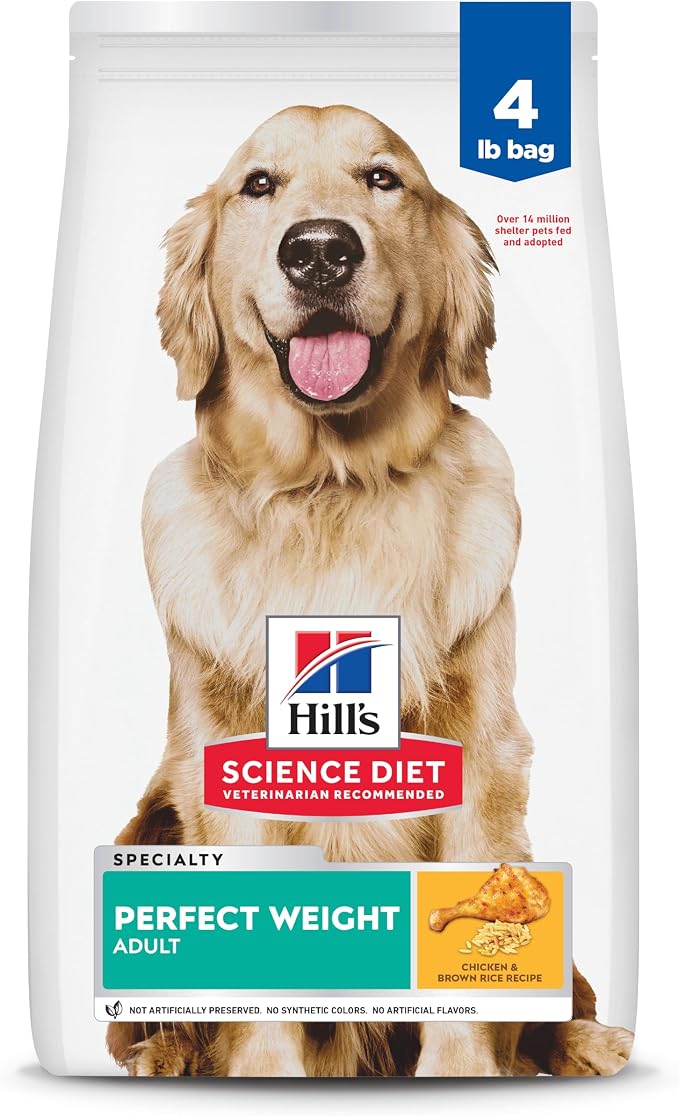
| Hill’s Science Diet Adult Perfect Weight | Overweight adult Corgis | Weight-loss formula with about 10.3% fiber and 28.8% protein (dry matter), per Hill’s | Adults only. Hill’s does not recommend it for puppies |
| Purina Pro Plan Weight Management (Shredded Blend, Chicken & Rice) | Adults that need to slim down, picky eaters | Reduced-fat adult formula with probiotics, widely sold | Purina label PDFs show different calorie counts by version, so read your bag |
| Wellness CORE Healthy Weight | Owners who want a reduced-fat, grain-free recipe | Retailer listings describe a reduced-fat, higher-protein recipe | Grain-free: the FDA has investigated a possible link with dilated cardiomyopathy, so ask your vet first |
| Royal Canin Medium Adult | Healthy adult Corgis at a normal weight | Made for adults of 23 to 55 lb, 340 kcal per cup, per Royal Canin | Not a weight-loss food. It has no fat-loss claim, so portions still matter |
| Royal Canin Medium Puppy | Corgi puppies up to a year old | Made for puppies expected to reach 23 to 55 lb as adults, 410 kcal per cup, per Royal Canin | Calorie-dense: measure it, because a chubby puppy is a chubby adult |
What does a Corgi’s body need from its food?
A Corgi needs a food that keeps a long, short-legged frame lean while still supplying complete nutrition. Total calories matter more than any single ingredient.
Why weight matters so much for this breed. Corgis are what vets call chondrodystrophic: short-legged breeds with altered cartilage development. The AKC Canine Health Foundation lists Corgis among the chondrodystrophic breeds that may be affected by intervertebral disc disease (IVDD), and states that “Obese dogs of predisposed breeds are especially likely to suffer from IVDD.” That does not mean your Corgi will get IVDD. It means excess weight is a risk factor you can control. Extra weight also adds load to the hips and other joints, which is why vets so often start any joint conversation with the scale.
Both kinds of Corgi. There are two breeds. According to the AKC, Cardigans have a long, foxlike tail while Pembrokes have a tail docked close to the body, and “Male Cardigans weigh up to 38 pounds while Pembrokes only weigh up to 30 pounds.” VCA lists the Cardigan at 25 to 38 pounds and a 12 to 15 year lifespan, and the Pembroke at 11 to 13 years. For feeding, the difference is simply size: use your own dog’s current weight (or target weight) and the calorie table below, not the breed name.
Appetite. Corgis are herding dogs that tend to be food-motivated, which is helpful in training and a problem at the fridge. Free-feeding a bowl all day is the quickest route to an overweight Corgi. Scheduled, measured meals are the standard fix.
How to choose a Corgi food
- An AAFCO statement for the right life stage. The FDA explains that a “complete and balanced” food must either meet an AAFCO nutrient profile or pass an AAFCO feeding trial, and that profiles exist for growth and reproduction versus adult maintenance. The breed name or a picture of a Corgi on the bag is not a substitute. The WSAVA Global Nutrition Guidelines hub also links a “Selecting a Pet Food” tool for label reading.
- Calorie density (kcal per cup). This is the number most owners ignore. Foods range widely: in this article alone, Hill’s Perfect Weight is 298 kcal per cup, Royal Canin Medium Adult is 340, and Royal Canin Medium Puppy is 410. A “cup” of one food is not a cup of another.
- Protein and fiber for weight control. Weight-management formulas generally lean on higher fiber and adequate protein to keep a dog fuller on fewer calories and to protect muscle while fat comes off.
- Kibble size. A Corgi is a medium dog, so standard adult or medium-breed kibble is fine. Tiny toy-breed kibble is not needed, and very large-breed kibble is unnecessary.
- Weight-management formula only when needed. A normal-weight Corgi does not need a diet food. Use a regular medium-breed adult formula and control portions.
- A reputable manufacturer that publishes its AAFCO method. Check whether the statement says “formulated to meet” or “feeding trials,” and confirm it on the bag you buy.
Foods worth considering
How we picked: label and manufacturer-feature analysis only. We have not fed these ourselves, and we do not quote ratings or prices because they change. Formulas and calorie counts change between bag versions, so always check your bag.
Hill’s Science Diet Adult Perfect Weight. The most clearly documented weight-loss option here. Hill’s lists 298 kcal per cup, 28.8% protein and 10.3% crude fiber on a dry-matter basis, and says the food provides complete and balanced nutrition for adult maintenance based on AAFCO feeding tests. Hill’s also claims over 70% of dogs lost weight within 10 weeks in its own study, which we have not verified. It is not intended for puppies, pregnant or nursing dogs.
Purina Pro Plan Weight Management (Shredded Blend, Chicken & Rice). A reduced-fat, protein-forward adult formula with probiotics, in the shredded-kibble style that some picky dogs prefer. Purina’s published label PDFs disagree on calories (roughly 330 to 354 kcal per cup depending on the version we found), so use the figure printed on your own bag when you work out cups.

Wellness CORE Healthy Weight. A grain-free, reduced-fat recipe. Retailer listings describe it as higher in protein and about 25% lower in fat than the brand’s original CORE recipe, but the numbers differ between listings, so confirm the guaranteed analysis on the bag. The grain-free caveat applies: the FDA has investigated a potential link between certain grain-free diets and dilated cardiomyopathy, so discuss it with your vet first.

Royal Canin Medium Adult. A medium-breed adult kibble for dogs over 12 months old weighing about 23 to 55 lb. Royal Canin lists 340 kcal per cup, an optimal-protein profile to support body condition, and an AAFCO adult-maintenance statement. It is a sensible default for a healthy-weight Corgi, but it is not a weight-loss formula, so measure it carefully.
Royal Canin Medium Puppy. Designed for puppies expected to reach 23 to 55 lb as adults, up to 12 months old. Royal Canin lists 410 kcal per cup, DHA and omega-3 fatty acids for brain development, and an AAFCO growth statement. That calorie density is why puppy portions need weighing.
What to feed a Corgi puppy
A Corgi puppy needs a food labeled for growth (puppy or all life stages), and a medium-breed puppy formula is the usual match because adult Corgis fall well under the 70 lb that defines large-breed growth. Feed measured meals, usually three or four a day when very young, then two as your vet advises.
- Follow the bag, then adjust by body condition. Feeding guides on the bag are a starting point. You should be able to feel the ribs under a thin layer of fat and see a waist from above.
- Do not free-feed a puppy. A chubby Corgi puppy is the easy way to an overweight adult. Weigh food on a kitchen scale.
- Switch foods slowly, over 7 to 10 days, one change at a time.
- Move to adult food at about 12 months, gradually. Royal Canin’s own medium puppy guidance runs to 12 months, and your vet can confirm timing for your dog.
- Keep jumping and stairs modest while the puppy grows, and talk to your vet about growth rate if your puppy seems to be gaining too quickly.
Puppy calorie targets are in the table below. The rule of thumb for puppies older than 4 months is a multiplier of 2.0, so recalculate every couple of weeks as your puppy grows. Younger puppies need more, so follow your vet’s guidance for the first four months.
How much to feed a Corgi by weight
Most Corgis eat less than owners expect. The table shows estimated calories per day, computed from the resting energy requirement: RER = 70 × (weight in kg)^0.75, multiplied by a life-stage factor. PetMD’s calorie guide by Jennifer Coates, DVM, gives the factors as 1.6 for a typical spayed or neutered adult, 1 for a dog that needs to lose weight, and 2 for a puppy older than 4 months (PetMD). Pounds are divided by 2.2 to get kilograms, and results are rounded to the nearest 5.
| Body weight | RER (resting) | Neutered adult at healthy weight (×1.6) | Weight loss, at target weight (×1.0) | Puppy 4 months+ (×2.0) |
|---|---|---|---|---|
| 15 lb (6.8 kg) | 295 kcal | 475 kcal | 295 kcal | 590 kcal |
| 20 lb (9.1 kg) | 365 kcal | 585 kcal | 365 kcal | 735 kcal |
| 25 lb (11.4 kg) | 435 kcal | 695 kcal | 435 kcal | 865 kcal |
| 30 lb (13.6 kg) | 495 kcal | 795 kcal | 495 kcal | 995 kcal |
| 35 lb (15.9 kg) | 560 kcal | 890 kcal | 560 kcal | 1,115 kcal |
Worked example: a 25 lb neutered adult is 25 ÷ 2.2 = 11.36 kg. 11.36^0.75 is about 6.19, times 70 is 433 kcal (RER). Times 1.6 is about 695 kcal a day.
How to read the weight-loss column. Use your Corgi’s target weight, not the current weight, and agree on that target with your vet. A Corgi that weighs 35 lb but should weigh 28 lb is fed for 28 lb. These puppy rows assume the puppy has reached that weight. A 4-month-old Corgi usually weighs well under 20 lb, so use the lower rows for young puppies.
Cups depend on calorie density. Divide the daily calories by the kcal per cup on your bag. For example, a 25 lb Corgi losing weight at 435 kcal a day on Hill’s Perfect Weight (298 kcal per cup) gets about 1.5 cups a day, split into two meals. The same dog at a healthy weight (695 kcal) would be about 2.3 cups of that food. Our dog calorie calculator does the division for you. These are estimates: intact, very active, underweight or senior dogs differ, and treats count. Adjust by body condition and your vet’s advice, and weigh your dog monthly.
Overweight Corgi: how to slim one down safely
Weight gain in Corgis is usually slow, then suddenly obvious. A few habits do most of the work:
- Confirm the problem. Check body condition: you should feel the ribs without pressing hard, and see a waist behind the ribs from above. Ask your vet to set a target weight.
- Feed for the target weight using the weight-loss column above, or a weight-management formula, and weigh meals on a kitchen scale instead of using a scoop.
- Count everything. Treats, chews, dental sticks, table scraps and bites of the dog’s training food are all calories.
- Weigh monthly and adjust. If weight isn’t falling after several weeks, tell your vet rather than cutting food sharply on your own.
- Do not crash diet. Rapid weight loss is a vet-supervised job, and some dogs need a prescription diet.
If the weight gain appeared suddenly, or came with tiredness, coat changes or a large appetite, tell your vet before changing the food. For high-fiber options for weight loss, see our high-fiber dog food guide, and see our hypothyroidism food guide if your vet has raised a thyroid cause.
Treats, begging and training food
A Corgi will turn begging into a full-time job. The practical rules are simple:
- Cap treats at roughly a tenth of the day’s calories, a common vet guideline, and subtract them from the meal.
- Use part of the meal as training treats. Corgis are food-motivated, so kibble works well as a reward.
- Choose low-calorie treats such as plain carrot pieces or green beans. The AKC lists these among fruits and vegetables dogs can generally eat in moderation, plain and unseasoned.
- Do not reward begging. Feed the family first, put the dog in another room, or give a puzzle feeder.
- Make everyone follow the rules. One generous relative can undo a month of careful portions.
Foods Corgis should not eat
Corgis are medium dogs, but a small bite of a toxic food can still cause trouble. Per the ASPCA’s list of people foods to avoid:
| Food | Why |
|---|---|
| Grapes and raisins | Can lead to kidney damage. |
| Onions, garlic, chives | Can irritate the GI tract and damage red blood cells, causing anemia. |
| Chocolate | Methylxanthines can cause vomiting, diarrhea, tremors, seizures and abnormal heart rhythm. Darker and baking chocolate are the most dangerous. |
| Xylitol (gum, candy, baked goods, toothpaste) | Can cause low blood sugar and potentially liver damage. |
| Macadamia nuts | Weakness, incoordination, vomiting, tremors and raised body temperature, usually within 12 hours. |
| Alcohol | Can cause vomiting, incoordination, breathing difficulty, tremors and coma. |
If your Corgi eats any of these, note the amount and call your vet or the ASPCA Animal Poison Control Center at (888) 426-4435 right away. Also skip cooked bones and fatty scraps, which are a choking and digestive-upset risk.
Feeding a senior Corgi
Corgis often live into their teens: VCA lists 11 to 13 years for the Pembroke and 12 to 15 for the Cardigan. Seniors need the same discipline with calories, plus attention to comfort:
- Calories fall with activity. Many older dogs need less food. Recalculate from the current weight and body condition rather than from habit.
- Keep protein quality high. Older dogs lose muscle easily, so do not simply cut food. Choose a senior or adult formula appropriate for your dog and discuss it with your vet.
- Watch the scale and the stairs. VCA’s Cardigan page says the breed is prone to back problems and that degenerative myelopathy “can cause progressive weakness later in life.” Tell your vet about wobbling, dragging paws, reluctance to jump or any weakness. These are signs to discuss with your vet, and they are not something food can fix.
- Reduce jumping. For a long-backed dog, cutting out the leaps on and off furniture and into cars is common sense. A ramp does that job; our dog ramp calculator shows the length you need, and our best dog ramps guide compares options.
- Cover slippery floors with runners so your Corgi has traction.
Our senior dog mobility guide covers the day-to-day side, and our senior dog food guide compares formulas built for later life.
Have a different breed with a weight problem? See our French Bulldog food guide and Rottweiler food guide.
For food-motivated Corgis, a few pieces of plain cooked liver make a strong training reward without many calories; see how to cook beef liver for dogs.
FAQ
What is the best dog food for Corgis?
There is no single best food. A complete-and-balanced formula for your Corgi’s life stage, fed in measured portions, is the safest start. Healthy adults usually do well on a medium-breed adult food such as Royal Canin Medium Adult. An overweight Corgi may need a weight-management formula such as Hill’s Science Diet Adult Perfect Weight. Confirm with your vet.
What should I feed a Corgi puppy?
A medium-breed puppy food (or an all-life-stages food) with an AAFCO growth statement, in measured meals, until about 12 months. Royal Canin Medium Puppy is one example designed for puppies expected to weigh 23 to 55 lb as adults. Weigh the food, because a chubby puppy is likely to become an overweight adult.
How much should I feed my Corgi?
A neutered adult Corgi at a healthy 25 lb needs roughly 695 calories a day by the standard formula, and a 30 lb dog about 795. Convert that to cups using the kcal per cup on your bag, or use our calorie calculator. Adjust by body condition.
Why is my Corgi so fat, and how do I help my overweight Corgi lose weight?
VCA says Pembrokes tend to be overweight, and the breed is food-motivated. Ask your vet to set a target weight, feed calories for that target, count treats, and weigh monthly. A weight-management food can help, but portions matter more than the brand.
Is overweight a real problem for a Corgi’s back?
Yes, it is a risk factor. The AKC Canine Health Foundation lists Corgis among breeds that may be affected by IVDD, and says obese dogs of predisposed breeds are especially likely to suffer from it. A healthy weight lowers that risk but does not guarantee anything.
What is the difference between Pembroke and Cardigan Corgis for feeding?
Mostly size. The AKC says male Cardigans weigh up to 38 pounds, while Pembrokes weigh up to 30. The Cardigan also has a long tail, and the Pembroke’s is docked close to the body. Feed by your own dog’s weight and condition, not by breed.
Do Corgis need large-breed puppy food?
No. Corgis stay under the 70 lb adult weight that defines large-breed growth, so a medium-breed puppy or all-life-stages food is the usual choice. Your vet can advise on your own puppy.
Should I feed my Corgi wet or dry food?
Either works if it is complete and balanced and the calories are counted. Dry is the simplest to measure. Wet food is more filling per calorie for some dogs but usually costs more. Whichever you use, match the calories to the table above.
When should a Corgi switch to senior food?
There is no fixed age. Switch on signs such as weight change, lower activity or a change in appetite, usually in the later years, rather than on a birthday. Our senior dog food guide walks through the transition.
The bottom line
For a Corgi, the food matters less than the amount. Pick a complete-and-balanced formula for the right life stage, weigh every meal, count every treat and keep the dog lean, because that protects a long back and tired hips more than any single ingredient. Our senior dog nutrition guide picks up where this one leaves off.