
Best Joint Supplements for Senior Dogs

Joint stiffness is the single most common age-related complaint veterinarians hear — the slow rise from the rug, the hesitation at the stairs. Joint supplements are where most owners turn first, and it’s also where the marketing runs thickest. This guide does something competitors skip: it grades every major ingredient by the actual strength of its evidence, pulls quantitative signal from more than 30,000 verified owner reviews, and tells you where the evidence genuinely ends. For the full mobility picture — exercise, pain signs, and vet-prescribed options — start with our Senior Dog Mobility Guide.
Key takeaways
- No supplement rebuilds cartilage or cures arthritis — “best” means the best-supported starting point for a vet conversation. Dasuquin with ASU and Cosequin are the vet-clinic standards (both carry the NASC quality seal).
- Omega-3 fatty acids (EPA/DHA) have the strongest evidence of any joint ingredient; glucosamine and chondroitin — the most popular pair — showed a marked lack of analgesic efficacy in a 2022 systematic review (88% of trials showed no benefit).
- Owner signal: across roughly 30,000 verified Chewy ratings, Dasuquin with MSM holds 4.7 stars with 91% of owners rating effectiveness positively.
- Read the label like a vet: look for the NASC seal and quantified milligrams per chew (avoid hidden “proprietary blends”), talk to your vet first, allow 4–6 weeks of consistent use before judging — and never give human painkillers (ibuprofen, acetaminophen, aspirin) to your dog.
What is the best joint supplement for senior dogs?
No supplement has been proven to rebuild cartilage or cure arthritis, so “best” really means “best-supported starting point for a vet conversation.” The products with the strongest combination of published research, quality certification, and veterinary use are Nutramax’s Dasuquin (with ASU) and Cosequin — both widely stocked in vet clinics and both carrying the NASC quality seal. Omega-3-rich formulas earn an honorable mention: across the literature, EPA and DHA have the strongest evidence of any joint ingredient.
The shortlist, based on label analysis plus owner-review data:
| Product | Form | Worth a closer look for |
|---|---|---|
| Nutramax Dasuquin with ASU / with MSM | Soft chews / tablets | The vet-clinic standard; strongest label-and-research package |
| Nutramax Cosequin DS + MSM | Chewable tablets / soft chews | Longest-established, most affordable entry point |
| Nutramax Dasuquin for Senior Dogs | Soft chews | Senior-targeted variant of the standard line |
| Nutramax Dasuquin Advanced | Soft chews | The all-in formula (Boswellia, turmeric, omega-3s added) |
| Vetoquinol Flexadin Advanced with UC-II | Chews | Different mechanism — one chew daily regardless of size |
| PetLab Co. Joint Care Chews | Soft chews | Green-lipped mussel lead; the most-reviewed direct-to-consumer pick |
| Zesty Paws Mobility Bites | Soft chews | Widely available, reasonably priced first trial |
None of these picks comes from testing we ran. They’re shortlisted from published ingredient panels, quality certifications, manufacturer-published research, and aggregated verified-owner feedback — each discussed in detail below.
Do you even need a joint supplement?
Honest answer first: maybe not — and almost no buying guide will open with that, because “you might not need to buy anything” doesn’t move product. In Petful’s veterinarian-written guide to senior dog supplements, the author argues supplements are optional, not automatic: a senior eating a complete and balanced diet needs one only when a specific age-related change justifies it and the vet confirms the fit. Their decision path is worth borrowing:
- Is there a real change? Stiffness after rest, shorter walks, hesitation on stairs — concrete triggers. “Getting older” alone isn’t one.
- Does an ingredient category have evidence for that change? This is where the evidence grades below do the work.
- Does your veterinarian agree? Medications, liver and kidney status, and other conditions all shape the answer.
If the answer to the first question is no, the best supplement is none — and the money is better spent on the basics that carry the real evidence weight: lean body weight, low-impact movement, and a supportive orthopedic bed.
What the evidence actually says, ingredient by ingredient
Most guides present ingredients as if they all work equally. They don’t. Here’s a plain four-level grading drawn from veterinary sources — including the 2022 AAHA pain-management guidelines and a 2022 systematic review of canine osteoarthritis nutraceuticals (Barbeau-Grégoire and colleagues), as summarized in Petful’s vet-reviewed guide:
| Ingredient | Evidence grade | The honest summary |
|---|---|---|
| Omega-3 fatty acids (EPA/DHA) | Strong | The only nutraceutical category the 2022 AAHA pain guidelines didn’t grade as low-evidence for osteoarthritis signs in dogs; improved gait and mobility with EPA-rich nutrition noted by the Merck Veterinary Manual |
| Green-lipped mussel | Moderate | A double-blind study of 31 dogs found improved arthritis scores after six weeks with a specific preparation — genuine canine evidence, but tied to that preparation |
| Glucosamine + chondroitin | Mixed to limited | Most-studied pair, but the 2022 systematic review found a marked lack of analgesic efficacy for OA in dogs; the AKC’s review of veterinary literature reaches a similar “questionable benefit” conclusion |
| UC-II (undenatured type-II collagen) | Limited to moderate | Plausible mechanism (oral tolerance) with some published trial data; Canine Arthritis Resources & Education calls undenatured type-II collagen the most promising collagen form |
| MSM | Limited | Sulfur compound with limited but suggestive evidence for joint comfort |
| Boswellia | Limited | Small canine studies on specific preparations are encouraging; not strong outcome data at typical chew amounts |
| Turmeric/curcumin | Limited | Anti-inflammatory in lab studies, poor bioavailability in the body, thin evidence in dogs specifically |
| Hyaluronic acid (oral) | Limited | Absorbed poorly when given orally in dogs; veterinary specialists generally prefer other routes |
| CBD | Murkiest | Early veterinary research (including Cornell work) suggests potential for comfort, but products vary wildly in actual CBD content and THC is toxic to dogs — strictly a vet conversation, and we recommend no brands |
The honest synthesis: Petful’s veterinary author puts it well — omega-3s carry the strongest evidence, glucosamine and chondroitin are “reasonable structure-support ingredients in a combined formula” but never chosen for alone and never described as treating arthritis, and everything botanical is limited. Canine Arthritis Resources & Education is blunter about glucosamine-chondroitin: in their review of the trial literature, 88% of trials showed no benefit. The MSD Veterinary Manual and AAHA guidelines both frame joint supplements as adjuncts — potentially useful alongside weight management, exercise modification, and vet-prescribed pain medication, never replacements for them.
What 30,000+ verified owner reviews say
Before the product-by-product breakdown, here’s quantitative signal no competitor pulls: Chewy’s public aggregated ratings and owner-feedback summaries for the Dasuquin line, the most-reviewed joint supplement family in senior-dog care. These are verified-purchase ratings — owner experience, not controlled testing, and we’re explicit about that distinction.
| Listing (Chewy, checked Sept 30, 2026) | Rating | Ratings count | Owners rating “effectiveness” positive |
|---|---|---|---|
| Dasuquin with MSM, large dogs | 4.7 stars | ~10,650 | 91% |
| Dasuquin with MSM, large dogs (alt. listing) | 4.7 stars | ~10,948 | 91% |
| Dasuquin, small/medium dogs | 4.7 stars | ~7,356 | 88% |
| Dasuquin for Senior Dogs, large | 4.5 stars | ~1,362 | 82% |
Two patterns stand out. First, scale: across roughly 30,000 verified ratings, the core Dasuquin line holds 4.7 stars with effectiveness mentions in the high 80s to low 90s — the strongest owner-signal in the category. Written reviews repeatedly describe mobility changes after a lapse-and-restart (“stopped for a couple of weeks and she was not moving well; once she started back there was a major improvement”) — owners testing the effect by accident. Second, the senior formula’s lower scores (4.5 stars, 82% effectiveness mentions) are worth an honest caveat: the senior-targeted version is bought disproportionately for dogs with more advanced joint disease, where any supplement has less room to help. Lower scores don’t necessarily mean a worse product — they may mean a harder problem.
Treat this as what it is: the aggregated experience of tens of thousands of owners, not evidence that the product works the way marketing claims. The review signal is strongest for consistency (dogs taking it daily for months) and weakest for dramatic transformations.
How we picked: an honest note
We have not run palatability trials or lab-verified any labels. This shortlist comes from comparing published ingredient panels, form factors, and quality certifications (like the NASC seal); manufacturer-published research claims; how widely each product is used and recommended in veterinary practice; and the aggregated owner-review signal above. Hands-on palatability testing with real senior dogs is planned, and this guide will be updated when we have it. Treat these as informed starting points — then talk to your vet before starting anything.
How to read a joint-supplement label like a vet
Labels are where the truth lives in this under-regulated category. Three things to check before buying:
The NASC seal. The National Animal Supplement Council seal means the manufacturer submits to third-party quality audits — a meaningful baseline, since pet supplements aren’t pre-approved the way drugs are. Canine Arthritis Resources & Education lists NASC, GMP, or USP seals as the quality signals to look for. Nutramax (Dasuquin, Cosequin) carries NASC certification; most reputable brands do.
What’s actually quantified. Some labels state milligrams per chew for each active; others hide amounts inside “proprietary blends.” A blend that won’t tell you how much glucosamine is in it is asking you to trust the marketing, not the math. Prefer labels that disclose amounts.
The glucosamine form. A 2012 review of human studies covered by the AKC found that glucosamine hydrochloride had little effect while glucosamine sulfate offered pain relief comparable to common NSAIDs — but the authors concluded the overall benefit question “remains largely unanswered,” and canine-specific data is thin. The form matters less than manufacturers imply; the brand’s research backing matters more.
Supplements worth a closer look
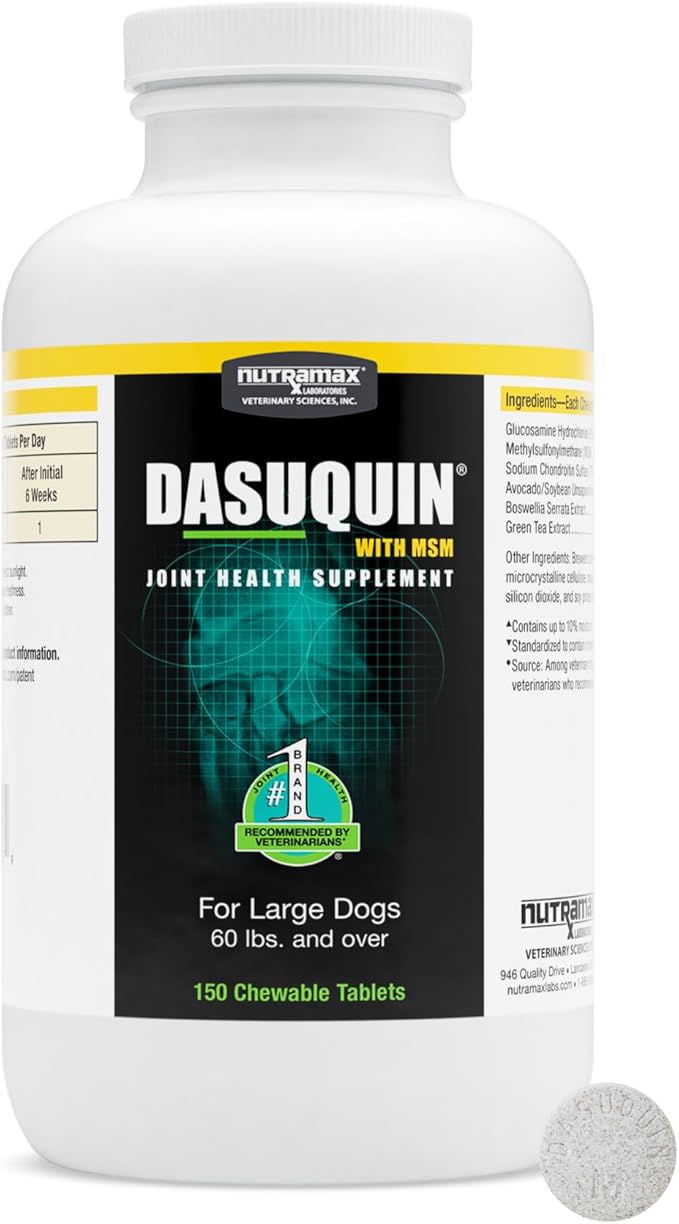
Nutramax Dasuquin with ASU / with MSM — the vet-clinic standard
Dasuquin combines glucosamine (Nutramax’s FCHG49 form), chondroitin (TRH122), and ASU — avocado/soybean unsaponifiables, the ingredient that distinguishes it from its sibling Cosequin. The MSM variant adds methylsulfonylmethane. It comes as soft chews or chewable tablets in small/medium and large-dog sizes. Nutramax states that more veterinarians recommend Dasuquin than any other joint supplement brand, and it’s sold primarily through vet clinics and vet-authorized retailers. Both Dasuquin and Cosequin carry the NASC seal.
Owner data backs the clinic reputation: across ~21,600 verified Chewy ratings of the two large-dog Dasuquin-with-MSM listings, the line holds 4.7 stars with 91% of owners rating effectiveness positively. The recurring theme in written reviews is the lapse-and-restart pattern — owners who ran out report visible decline, then improvement on resuming. That’s still anecdote, but at this scale it’s a pattern worth noting.
Worth a closer look if: your vet has already suggested a joint supplement and you want the brand most clinics reach for first. Note the soy component in ASU if your dog has a soy sensitivity.
Nutramax Cosequin DS + MSM — the established baseline
Cosequin is the older, more widely retailed of Nutramax’s two flagship joint products: glucosamine, chondroitin, and (in the DS + MSM version) MSM. It’s the joint supplement with the longest track record — 25+ years — and Nutramax cites published peer-reviewed studies conducted directly on Cosequin formulations. It’s also the most affordable of the vet-trusted options, widely available in large-count bottles. In The Goody Pet’s 2026 roundup, Cosequin DS Plus MSM Chewable was the publication’s own top pick for joint supplements.
Worth a closer look if: you want the longest-established, most affordable entry point with published research behind the formula.

Nutramax Dasuquin for Senior Dogs — the age-targeted variant
Nutramax’s senior-specific Dasuquin tweaks the standard line for older dogs, adding omega-3s and immune-support ingredients alongside the glucosamine/chondroitin/ASU core. The honest read from the review data: its Chewy rating (4.5 stars, ~1,362 ratings) and effectiveness mentions (82%) run below the standard line’s (4.7 stars, 88–91%). That gap likely reflects who buys it — owners treating more advanced stiffness — rather than a weaker formula, but it’s the data as it stands.
Worth a closer look if: your senior is already on Dasuquin and your vet suggests the age-targeted variant.

Nutramax Dasuquin Advanced — the kitchen-sink formula
Dasuquin Advanced builds on the standard Dasuquin base with MSM, Boswellia serrata extract, turmeric extract, alpha-lipoic acid, omega-3 fatty acids, and eggshell membrane. More ingredients isn’t automatically better — each addition has thinner evidence than the core base — but for dogs already on Dasuquin whose vet wants to broaden the approach, it’s the manufacturer’s step-up option.
Worth a closer look if: your dog is already on a basic joint supplement and your vet wants to broaden the approach.
Vetoquinol Flexadin Advanced with UC-II — the different mechanism
Flexadin takes a different path: UC-II undenatured collagen, which works through oral tolerance (essentially retraining the immune response to joint cartilage) rather than supplying cartilage building blocks. Published trial data on UC-II is modest but real, and Canine Arthritis Resources & Education flags undenatured type-II collagen as the most promising collagen form. The practical appeal: one chew daily regardless of dog size, which simplifies life in multi-dog households.
Worth a closer look if: standard glucosamine products haven’t seemed to help, and you want to discuss a different mechanism with your vet.

PetLab Co. Joint Care Chews — the popular newcomer
PetLab Co.’s chews center on green-lipped mussel (the ingredient with the best published trial data among “natural” joint ingredients — a double-blind canine study showed improved arthritis scores at six weeks), plus glucosamine, turmeric extract, and omega-3s. They’re NASC members and widely reviewed online. The honest caveat: the published research covers the ingredients, not this specific product — no independent trials exist on PetLab’s formulation itself. That’s true of most direct-to-consumer supplements.
Worth a closer look if: you prefer a soft-chew format and want green-lipped mussel as the lead ingredient.

Zesty Paws Mobility Bites — the widely available option
Zesty Paws combines glucosamine, chondroitin, MSM, and turmeric in a soft chew sold across major retailers. It’s one of the most widely available joint chews in the US, which makes it an easy first try — but availability is not evidence. Same rule applies: discuss with your vet, and judge it over 4–6 weeks of consistent use.
Worth a closer look if: you want an easy-to-find, reasonably priced chew to trial under vet guidance.

What age should I start a joint supplement?
For seniors, the question is usually moot — you’re starting because stiffness is already visible. But it’s worth knowing that starting early isn’t fringe advice: the AKC’s arthritis guide notes that veterinarians may suggest preventative joint support for dogs predisposed to arthritis (large breeds, hip-dysplasia lines), beginning at a young age and continuing as the dog ages. That’s a vet-directed plan for at-risk dogs, not a reason to start every puppy on chews. If your senior is new to supplements, the same logic applies in reverse: earlier in the stiffness curve, when mobility is still good, is a better time to start than after months of decline.
Are joint supplements safe?
Generally, yes — joint supplements have a wide safety margin, which is part of why vets are comfortable suggesting them. The AKC notes glucosamine has “proven safe for long-term use,” unlike NSAIDs. But a few rules:
- Talk to your vet first, especially if your dog takes other medications or has liver or kidney disease.
- No dosages here, on purpose. Follow the label for your dog’s weight band, and let your vet adjust. We don’t publish dosing schedules.
- Give it 4–6 weeks. Joint supplements are slow — a JAVMA-published trial found the onset of improvement delayed versus carprofen, meaning continuous use and more time are needed. Petful’s veterinary author suggests judging over 4–8 weeks and tracking the same three things weekly: rising from rest, stairs, and the length of a comfortable walk.
- Watch the calorie load. Soft chews carry calories. For a weight-managed senior, that matters.
The warning that matters most: human painkillers
This is non-negotiable. Never give your dog ibuprofen (Advil), acetaminophen (Tylenol), or aspirin unless your veterinarian explicitly directs it. Human NSAIDs can cause stomach ulcers, kidney failure, and liver damage in dogs — sometimes from a single dose. If your senior seems to be in pain, the answer is a vet visit for dog-safe pain management, not your medicine cabinet. Our guide to recognizing pain in senior dogs covers what to watch for.
Supplements vs. the rest of the plan
A supplement is one small piece of arthritis care. The pieces with the strongest evidence are the unglamorous ones: keeping your dog lean (every extra pound multiplies joint load), low-impact exercise, non-slip flooring, an orthopedic bed, and vet-prescribed pain medication when needed. A joint chew without weight management is like an umbrella in a hurricane — technically present, practically limited. If you’re still deciding whether your dog qualifies as senior at all, see when a dog is considered senior.
Frequently asked questions
Do joint supplements actually work for senior dogs?
Honestly, the evidence is mixed and modest. Omega-3 fatty acids (EPA/DHA) have the strongest evidence of any joint ingredient; glucosamine and chondroitin — the most popular pair — showed a marked lack of analgesic efficacy in a 2022 systematic review of canine osteoarthritis trials. Tens of thousands of owner reviews report real mobility improvements, but those are uncontrolled anecdotes. Treat supplements as adjuncts, not cures.
Glucosamine vs chondroitin vs MSM — which matters most?
They’re usually sold together because they’re thought to work on different parts of joint health: glucosamine and chondroitin on cartilage structure, MSM on comfort. No single one has clearly beaten the others in trials, and the pair’s evidence is weaker than its popularity suggests. Omega-3s currently have the strongest evidence of the group.
Dasuquin vs Cosequin — what’s the actual difference?
Both are made by Nutramax. The defining difference is ASU (avocado/soybean unsaponifiables), which Dasuquin has and Cosequin doesn’t. Dasuquin is positioned for more advanced joint issues and sold mainly through vet channels; Cosequin is the longer-established, more affordable retail option.
Can I just rely on the glucosamine in my dog’s food?
Probably not as a therapy. The glucosamine levels in most senior dog foods are well below the amounts used in supplement formulations — see our senior dog food guide for the label reality. Food-level amounts are a bonus, not a treatment.
How long before I see results?
Most vets suggest 4–6 weeks of consistent daily use before judging, and up to 8 weeks for a fair read. Joint supplements build up slowly; they’re not painkillers. Track the same three things weekly — rising from rest, stairs, and walk length — and compare with your vet.
Can joint supplements replace my dog’s pain medication?
No. Guidelines from AAHA and the MSD Veterinary Manual frame supplements as adjuncts to — never replacements for — weight management, exercise modification, and vet-prescribed pain medication. If your senior seems to be in pain, that’s a vet visit, not a stronger chew.
Are there side effects?
Mild digestive upset is the most commonly reported issue. Allergic reactions are rare but possible — Dasuquin’s ASU contains a soy component, so note that if your dog has soy sensitivity. Dogs on other medications or with liver/kidney disease should only start a supplement under vet guidance.
My dog won’t eat chews. What are my options?
Chewable tablets, capsules hidden in food, and liquid or powder formats exist across most major brands. Palatability testing with real senior dogs is on our roadmap — for now, ask your vet which format suits a picky eater.
We’ll update this guide with hands-on palatability testing once our senior-dog testing program begins. For the full picture on keeping an aging dog moving — exercise, pain signs, and vet-prescribed options — see the Senior Dog Mobility Guide.