
Best Orthopedic Dog Beds for Senior Dogs

Senior dogs spend 14–18 hours a day on their bed — more time than they spend doing anything else, including walking, eating, or being at the vet. For an arthritic dog, those hours are either joint recovery or joint punishment, and the difference comes down to what’s inside the mattress. A genuinely supportive bed is one of the highest-impact, lowest-risk purchases in senior dog care. It belongs in the same conversation as ramps, rugs, and weight management — which is exactly how this guide treats it.
This is part of our Senior Dog Gear & Products pillar, and it pairs directly with our senior dog mobility guide. If your dog is showing new stiffness, our guide to how to tell if your senior dog is in pain is worth reading alongside this one — because a bed can only do its job once actual pain is being managed with your veterinarian.
Key takeaways
- Top picks on specs: Big Barker (7” layered foam, 10-year no-flatten warranty, the only bed with a published clinical pilot study), PetFusion Ultimate (Wirecutter’s pick, 4” solid CertiPUR-US foam, low entry), BullyBeds (7” foam, 20-year warranty), Bedsure (51,000+ Amazon reviews at 4.5★), FurHaven (budget), and Casper (firm support, 30-night trial).
- Shop by foam density, not just thickness — look for 4+ lb/ft³ (anything under 4 tends to flatten within a year). Thickness guide: 3–4” for dogs under 25 lb, 4–6” for 25–60 lb, 6–7” for 60+ lb or any arthritic dog.
- Entry height of 4–6 inches is the right range for seniors (over 8” requires a painful jump); a 3-sided bolster with an open front gives head support and a push-off edge without a climb-over problem.
- Non-negotiables: removable machine-washable cover, waterproof liner, non-slip bottom — and remember “orthopedic” is unregulated, so verify the specs instead of trusting the label.
What is the best orthopedic bed for a senior dog?
The best orthopedic bed is a thick, high-density foam mattress — at least 4 inches of solid foam, ideally 6–7 for dogs over 50 pounds — with foam density of 4+ pounds per cubic foot, a removable washable cover, a waterproof liner, a non-slip bottom, and a low step-in edge. On manufacturer-published specs, the strongest contenders are Big Barker (7” layered foam, 10-year no-flatten warranty, studied at UPenn), PetFusion Ultimate (Wirecutter’s pick, 4” solid CertiPUR-US foam, low entry), BullyBeds (7” foam, 20-year warranty), Bedsure (the mass-market favorite), FurHaven (budget), and Casper (firm support, arthritis-noted).
The shortlist, based on spec analysis and observed review data:
| Bed | Foam | Standout attribute |
|---|---|---|
| Big Barker Original | 7” layered (2” comfort / 3” support / 2” base) | Studied in a UPenn pilot; 10-year no-flatten warranty; made in USA |
| PetFusion Ultimate | 4–5” solid CertiPUR-US memory foam | Wirecutter’s pick; low entry; waterproof liner; replacement covers |
| BullyBeds 3-Sided Bolster | 7” CertiPUR-US orthopedic foam | 20-year warranty — strongest in the category; 3-sided open-front bolster |
| Bedsure Orthopedic | High-density egg-crate foam | 51,000+ Amazon reviews at 4.5★; #1 bestseller in its category |
| FurHaven Ultra Plush Lounger | Memory/egg-crate foam (varies by model) | Wirecutter 2022 lounger pick; budget-friendly; sizes up to 180-lb dogs |
| Casper Dog Bed | Layered foam inserts | Wirecutter-noted firm support for arthritic dogs; 30-night trial |
How we picked: an honest note
We have not compression-tested any foam, run wash cycles, or sleep-trialed these beds with real dogs. This shortlist comes from comparing manufacturer-published specifications — foam thickness, construction, density claims, cover materials, size ranges, warranties, and liners — cross-checked against large-scale verified-purchase review data and the published test findings of other outlets, always attributed in the text below. Hands-on testing is planned: foam compression measurements, wash-durability checks, and sleep trials with real senior dogs. Until then, these are spec-based starting points plus observed owner signals, not tested winners.
Do orthopedic beds actually help dogs with arthritis?
Yes, with an important qualification: a supportive bed is part of a pain and mobility plan, not a treatment. Canine arthritis guidance from CARE (Canine Arthritis Resources and Education) recommends supportive bedding such as memory foam mattresses, placed in a warm, draft-free area with non-slip flooring under and around the bed — bedding is listed alongside ramps and flooring as environmental management for dogs with osteoarthritis (caninearthritis.org).
The mechanism is straightforward. An arthritic dog wakes up stiffer than it went to bed: a bed that sinks under its weight forces joints into a curved position all night, which makes morning stiffness worse. A bed that holds the dog’s weight evenly keeps the spine aligned and lets the dog shift positions without pushing off a squishy surface. If your senior sleeps 16 hours a day, the bed is doing more joint work than anything else in the house — which is also why it can never replace pain treatment, weight management, or veterinary care. Discuss your dog’s arthritis plan with your veterinarian; the bed is the lowest-risk part of it.
What “orthopedic” actually means (and what it doesn’t)
Nothing official — the word is not regulated for pet products, so any manufacturer can print it on a label. When evaluating claims, ignore the label and check these specifics instead:
Solid foam, not fill. True orthopedic support comes from solid foam thick enough that your dog can’t bottom out onto the floor. Polyester fiberfill and shredded foam compress flat within months — a dog on a flattened pillow bed is effectively sleeping on the floor. Egg-crate foam is a middle ground: it breathes well and costs less, but alone it compresses faster under 60+ pounds and most experts recommend it only over a solid base.
Foam density, not just thickness. Density — the weight of one cubic foot of foam, measured in pounds per cubic foot (lb/ft³) — is the number that determines how long a bed holds its shape. Cheap memory foam at 2–3 lb/ft³ feels great for a few months, then pancakes. Love Old Pets advises looking for foam at 4.5 lb/ft³ or higher, noting that anything under 4 lb/ft³ tends to flatten within a year (loveoldpets.com). Thickness tells you how much support you get tonight; density tells you whether you’ll still have it next year.
CertiPUR-US certification. This certifies the foam is made without ozone depleters, PBDEs, mercury, lead, and formaldehyde, with low VOC emissions. It’s the most meaningful quality signal on a spec sheet — and the easiest way to verify a density claim, since the certification independently tests content, emissions, and durability.
Layered construction. Many of the best beds layer foams of different densities — a firm base, a supportive middle, a softer top — so the mattress both cushions joints and resists bottoming out. For dogs over 50 pounds, layered systems usually outperform a single slab of pure memory foam.
A removable, machine-washable cover plus a waterproof liner. Senior dogs have accidents, drool more, and shed. If the cover doesn’t come off and survive the washing machine, the bed has a short useful life. A waterproof liner between cover and foam is what stands between an accident and a ruined mattress.
A non-slip bottom. The most overlooked safety feature. A bed that slides when the dog steps on it forces the dog to brace against the slip — pulling on the same arthritic joints that hurt. This matters most on hardwood and tile, and Wirecutter specifically praised no-skid bottoms in its testing.
How thick should an orthopedic bed be?
Thickness should be matched to the dog’s weight, because the failure mode is bottoming out. A useful rule of thumb, consistent across the specialist guides we reviewed:
| Dog weight | Recommended foam thickness |
|---|---|
| Under 25 lbs | 3–4 inches (quality foam still required) |
| 25–60 lbs | 4–6 inches |
| 60+ lbs, or any arthritic dog | 6–7 inches |
If your dog limps after naps, avoids lying down, or keeps changing positions at night, the current bed likely isn’t supportive enough. When between sizes, size up — and always compare against the sleep surface, not the outer dimensions, on bolstered beds.
Entry height and bolsters: the shape that hurts or helps
This is the gap most “best bed” lists skip, and for an arthritic dog it matters as much as the foam.
Entry height is the distance from the floor to the top of the bed. Anything over 8 inches requires a small jump — the exact motion that pulls on arthritic hips, elbows, and shoulders. Love Old Pets recommends 4–6 inches of entry height as the right range for seniors (loveoldpets.com). If your senior struggles to climb onto a tall mattress, pair the bed with a ramp or choose a lower-profile option — the best bed is the one your dog can actually get onto.
The 3-sided bolster is the single biggest shape upgrade for arthritic dogs. A raised edge on three sides, with the front left open, does three jobs: it gives the dog something to rest its head and neck on, something to push against when standing up (the moment of the day that hurts most), and a sense of security. A round bed with bolsters all the way around forces the dog to climb over the edge to enter — the hardest motion for an arthritic dog.
Elevated cot-style beds are not for arthritic seniors. In Wirecutter’s testing, the K&H Original Pet Cot was praised for hot dogs and outdoor use, but the testers did not recommend it for older dogs or dogs with arthritis, because the height makes it harder to climb in and out (Wirecutter). Cooling and washability are real virtues — just not at the cost of access.
Beds worth a closer look
Big Barker Original — the studied heavyweight
Big Barker builds beds specifically for large and giant dogs, and the specs show it: 7 inches of American-made foam in three layers (2” comfort top, 3” support core, 2” base), CertiPUR-US certified, with a removable machine-washable microsuede cover plus a water-resistant inner liner. Sizes run Large (48” x 30”, dogs roughly 50–70 lb) through XL (52” x 36”) to Giant (60” x 48”, dogs up to 300 lb). The headline is the 10-year no-flatten warranty — the company guarantees the foam retains its shape, which is the exact failure mode of cheap beds. Three designs: Sleek (flat), Headrest (built-in pillow), and Sofa (raised bolsters).
What separates Big Barker from every other bed on this list is the research. In an open-label pilot study at the University of Pennsylvania School of Veterinary Medicine, 40 dogs (over 3 years old, over 70 lb, with radiographically confirmed osteoarthritis) spent 28 nights on Big Barker beds while wearing activity monitors; owners completed weekly Canine Orthopedic Index assessments. Owners reported improvements in quality of life, gait, joint stiffness, pain severity, and joint function (study PDF; summarized at justluxe.com). Note it honestly: this was an open-label pilot, not a blinded trial, and the study was initiated after UPenn clinicians approached the company — but it remains the only clinical study of its kind on a dog bed that we could find.
Worth a closer look if: you have a large or giant senior and want the thickest foam, the longest track record, and the only bed with published clinical data behind it. Premium priced (around $240 for the Original).

PetFusion Ultimate — the expert-tested all-rounder
PetFusion’s Ultimate pairs a solid 4-inch (5-inch on the XXL) CertiPUR-US memory foam base with recycled-polyfill bolsters around three sides — ideal for dogs that rest their chin on a raised edge, with the front open for entry. The cotton-poly twill cover is removable and washable, a waterproof liner protects the foam, and the bottom is non-skid. Sizes span Small (25” x 20”) to XXL (50” x 40”, rated for 200+ lb). Thoughtful extras: YKK zippers and replacement covers sold separately.
This is the bed the professional testers kept coming back to. In Wirecutter’s dog-bed testing, the PetFusion Ultimate was selected as the top pick — praised for easy senior access via the low entry point, wraparound bolstering for head support, quality stitching, a no-skid bottom, and a water-resistant cover with an inner liner for easy cleanup. Their noted caveats: side bolsters can lose shape over time (though they fluff up after washing and drying), and it sags more than some firmer options. (Wirecutter)
Worth a closer look if: you want the most expert-validated mid-range option — proper foam, a liner, a washable cover, and easy senior access — without the premium price.

BullyBeds 3-Sided Bolster — the warranty leader
Love Old Pets named the BullyBeds 3-Sided Bolster its pick for arthritic seniors, and the specs explain why: 7 inches of CertiPUR-US certified orthopedic foam at human-mattress-grade density, a three-sided bolster with an open low front (about 5 inches of entry height at the front), a removable machine-washable cover with a hidden zipper, a waterproof inner liner, and a non-slip bottom (loveoldpets.com). The differentiator is the warranty: 20 years against flattening and structural failure, which Love Old Pets calls the strongest warranty in the orthopedic bed category. Pricing starts at $159.99 for the medium — comparable to or below other beds of this spec.
Worth a closer look if: warranty length is your proxy for foam confidence — two decades of guaranteed support is unmatched.
Bedsure Orthopedic — the people’s choice
Bedsure’s orthopedic bed is the mass-market answer: high-density egg-crate foam, a four-sided bolster with a lowered entry, a waterproof liner, and a removable machine-washable cover. What makes it notable isn’t the spec sheet — it’s the scale of owner validation: over 51,000 Amazon reviews averaging 4.5 stars, and a #1 bestseller ranking in its category (thirstybear.com). Reviewers consistently praise the joint support for senior dogs and the waterproof layer’s accident saves; the recurring caution is that some long-term owners report newer production runs feeling slightly thinner than older ones. Note the honest trade-off: egg-crate foam breathes well and costs little, but it will not match the longevity of high-density solid foam under a heavy dog.
Worth a closer look if: you want the most owner-validated budget-mid option, or a second bed for another room.

FurHaven Ultra Plush Lounger — the budget pick, with a caveat
FurHaven sells some of the most widely bought orthopedic-style beds in the US, and the Ultra Plush Lounger earned its place as Wirecutter’s lounger pick in its 2022 dog-bed testing, noted for foam that held its shape under use (Wirecutter). Owner validation is enormous: one popular FurHaven listing carries 4.4 stars across nearly 80,000 Amazon ratings (amazon.com).
The caveat is the range. FurHaven sells everything from faux-fur memory-foam mattresses to thin egg-crate “orthopedic” versions — check the specific model’s foam type and thickness before buying, because the cheapest versions are the thin pads this guide warns against. Stick to the memory-foam models with removable, washable covers.
Worth a closer look if: budget is the constraint, or you need a smaller size the premium brands ignore — but verify the exact model’s foam specs.

Casper Dog Bed — the firm-support alternative
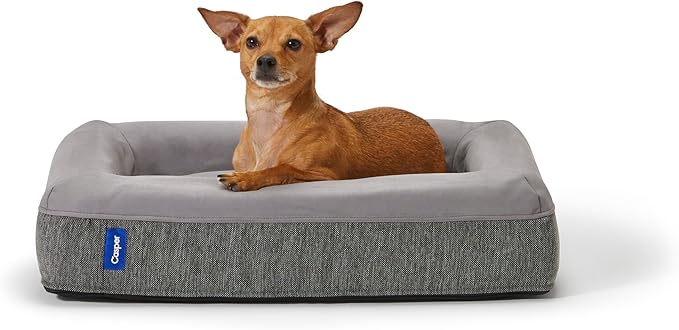
In Wirecutter’s testing, the Casper Dog Bed was noted as a strong option for older dogs and dogs with arthritis that need firm support, with easier assembly than similar multi-piece beds, a 30-night risk-free trial, and a one-year warranty (Wirecutter). The caveats: narrow 2–3 inch bolsters (less of a nest feel), only three sizes (up to 90-lb dogs), and light colors that show grime. It’s the pick for the owner who wants a human-mattress-brand feel and a trial period.
What owner reviews actually say (and what they don’t)
Review counts are not test results, but at scale they reveal failure modes. Reading across tens of thousands of verified-purchase ratings:
- Big Barker: Amazon listings show roughly 4.6–4.7 stars across ~6,000–8,800 ratings, with about 83% awarding five stars on one widely cited listing (reviewatlas.co); on the company’s own site, the bed shows 4.9 from 10,000+ reviews. The recurring themes are lasting support under giant breeds and the warranty; the recurring complaints are price and weight.
- PetFusion Ultimate: roughly 4.7 stars across ~19,000+ Amazon ratings (one size alone shows 19,434 ratings at 4.7), with review-authenticity analysis grading the review profile highly trustworthy. Owners praise the low entry for seniors and the washable cover; the most common complaint mirrors Wirecutter’s — bolsters softening over time.
- Bedsure: 51,000+ reviews at 4.5 stars — the largest owner sample in the category — with joint support and the waterproof liner as the most praised features and thinning in newer batches as the watch item.
- FurHaven: up to ~80,000 ratings at 4.4 stars on popular listings — enormous sample, slightly lower average, consistent with a budget bed that pleases many but flattens sooner under heavy dogs.
None of this is our testing. It is observed owner signal, and it agrees with the spec analysis: denser foam and longer warranties correlate with happier long-term owners.
How to choose the right size (and where to put it)
Measure your dog lying stretched out, nose to tail base, then add 6–12 inches. A bed that’s too small forces curled sleeping that stiffens arthritic joints overnight; too large just wastes floor space. For weight guidance, use the manufacturer’s dog-weight ranges, not the bed’s dimensions alone — a 40-lb dog and an 80-lb dog need very different foam performance from the same footprint. When between sizes, size up.
Placement matters as much as the mattress. CARE’s osteoarthritis guidance recommends bedding in a warm, draft-free area with non-slip flooring under and around the bed (caninearthritis.org). Put the bed where your senior already chooses to sleep — routine matters more than theory — on a rug or mat that won’t slide when they push up. If getting up is the hard part, our mobility guide covers the full picture, from flooring to harnesses.
How much should you spend?
Expect three rough tiers. Budget ($30–$70): FurHaven-style beds — genuine foam, but thinner and lower-density, with shorter-lived covers and short warranties. Fine as a second bed or a trial to learn your dog’s preferred style before investing. Mid-range ($80–$160): PetFusion and Bedsure territory — solid or high-density foam, waterproof liners, replaceable covers, real warranties. The sweet spot for most seniors: proper support without the premium markup. Premium ($160–$250+): Big Barker and BullyBeds — the thickest, densest foam and decade-plus warranties. Justifiable for giant breeds, where cheap beds fail fastest and the cost-per-year math actually favors buying once.
Whatever tier you choose, price-per-year beats sticker price. A $40 bed that pancakes in six months costs more than a $140 bed that lasts five years — and your dog pays the difference in comfort every night in between.
Caring for the bed (and knowing when to replace it)
Wash the cover on the schedule your dog dictates — weekly for droolers or incontinent seniors. The waterproof liner is what stands between an accident and a ruined mattress; if your bed didn’t come with one, a waterproof mattress protector underneath works. Replace the bed when the foam no longer rebounds after your dog gets up, when you can feel the floor through it, or when the cover’s zippers and seams give out. A quality foam bed should last years; a cheap fill bed often pancakes within months — which is exactly what the warranties above are betting against. When the cover finally wears through on a good foam core, check whether the manufacturer sells replacement covers before replacing the whole bed.
Frequently asked questions
Are orthopedic beds worth it for senior dogs?
For arthritic or heavy seniors, yes. Supportive bedding is recommended in veterinary osteoarthritis guidance, and it’s one of the few purchases where the benefit is obvious the first morning: easier rising, less restlessness overnight. It’s part of a pain plan, not a substitute for veterinary care.
Do orthopedic dog beds help with arthritis?
They can’t treat arthritis — nothing you buy can — but a high-density foam bed reduces the overnight joint stress that makes mornings worse. In the UPenn pilot study on Big Barker beds, owners of osteoarthritic dogs reported improvements in stiffness, pain severity, and mobility after 28 nights. Manage expectations: comfort support, not a cure.
How thick should an orthopedic dog bed be?
3–4 inches for dogs under 25 lb, 4–6 inches for 25–60 lb, and 6–7 inches for dogs over 60 lb or any arthritic dog. Density matters more than thickness for longevity — look for 4+ lb/ft³ or CertiPUR-US certification.
Memory foam vs. egg-crate foam — does it matter?
Yes. Solid memory foam distributes weight and resists bottoming out; egg-crate foam is cheaper, breathes better, and compresses faster under heavier dogs. For an arthritic senior over 50 pounds, solid or layered high-density foam is the honest choice; egg-crate works for smaller or lighter dogs.
What is the best entry height for an arthritic dog?
4–6 inches is the right range. Anything over 8 inches requires a small jump that pulls on arthritic hips and shoulders. A 3-sided bolster with an open front gives head support and a push-off edge without the climb-over problem of round bolster beds.
Are heated beds safe for senior dogs?
Low-wattage heated beds designed for pets are generally safe, but they need intact cords, chew-proofing, and supervision for dogs that can’t move away from heat well. Heat is a comfort aid, not a therapy — and it adds electrical risk, so weigh it against a warm draft-free bed location first.
How often should I replace my senior dog’s bed?
When the foam stops rebounding or your dog can feel the floor through it. Quality high-density foam lasts years; cheap fill can flatten in months. Washable covers and replacement covers extend useful life significantly — check whether the manufacturer sells covers before replacing the whole bed.
Should I get a bolster bed or a flat mattress?
It depends on sleeping style. Curlers and chin-resters do better with a 3-sided bolster (open front for entry); dedicated sprawlers and hot sleepers do better flat. Watch how your dog sleeps for a few nights before choosing — don’t guess.
We’ll update this guide with foam-compression measurements, wash tests, and real sleep trials once our senior-dog testing program begins. For the complete senior-dog setup — beds, ramps, harnesses, and more — see Essential Products for Senior Dogs, and for the nutrition half of joint care, see Best Dog Food for Senior Dogs.