Best Dog Food for American Bully Dogs
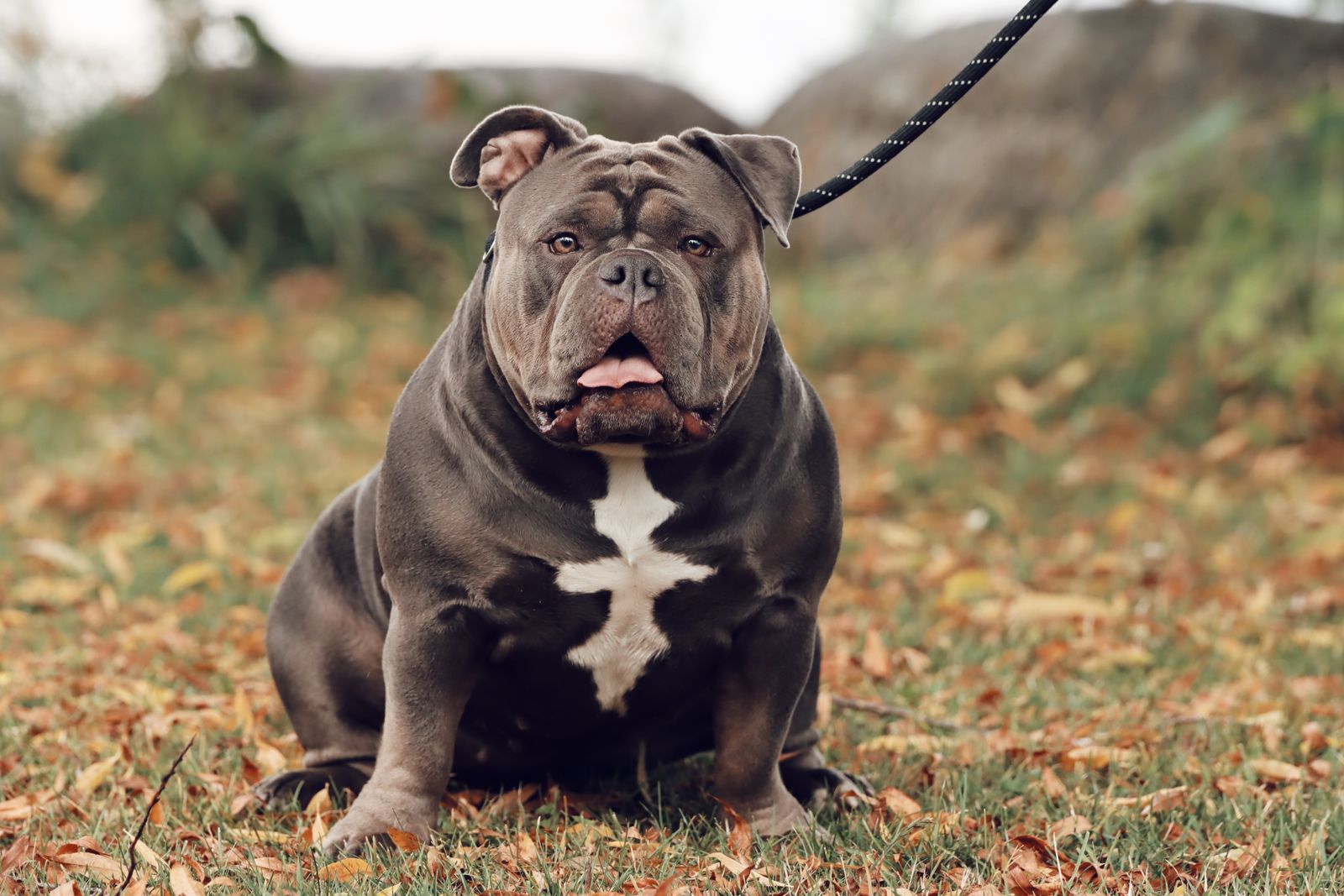
The best food for an American Bully is a complete, high-quality dry food with 25–30% protein from named animal sources, fat matched to activity, and measured portions based on ideal weight — and for puppies, a food labeled for growth of large-size dogs. There is no official “bully breed” food, so what matters is the label, the calories per cup, and how much goes in the bowl. Below: a feeding table by weight (with the math shown), puppy rules, a quick comparison, and the formulas we looked at. For the bigger picture, see our senior dog nutrition guide.
Key takeaways
- Feed 25–30% crude protein from named animal sources (beef, chicken, fish, or their meals) and 12–20% crude fat matched to activity, with portions anchored to your dog’s ideal weight — and ignore the kidney myth: high protein doesn’t damage healthy dogs’ kidneys.
- There is no such thing as “bully-specific” food: AAFCO has no breed-specific nutrient profile, so judge every bag on protein, fat, calorie density (kcal/cup), and the AAFCO statement — the rest is marketing.
- The breed’s biggest nutrition problem is overfeeding, not underfeeding: Bullies are easy keepers, and a 90-pound Bully eating 4 cups of a 535 kcal/cup formula gets over 2,100 kcal — measure every meal, learn body-condition scoring, and weigh monthly.
- Formulas are compared on label and spec in the table below; no hands-on feeding trials yet. Bully Max 25/11 is the smarter pick for the common case, a Bully that needs to lose weight.
- Skin issues are mostly environmental, not food: the only reliable diagnosis is an elimination-challenge trial with your vet (one novel or hydrolyzed protein, at least 8 weeks), and omega-3s are the best-supported nutritional lever for skin. On grain-free: the DCM association tracks with pulse-heavy diets (peas, lentils, chickpeas), not with the mere absence of grains.
At a glance: formulas compared
| Product | Best for | Why it fits | Watch out for |
|---|---|---|---|
| VICTOR Hi-Pro Plus (30/20) | Active adult Bullies | 30% protein, 20% fat, ~405 kcal/cup, all life stages | Easy to overfeed a sedentary dog |
| Bully Max 30/20 | Hard keepers, very active dogs | 30% protein, 20% fat, ~535 kcal/cup | Very calorie-dense; contains sorghum and brown rice (not grain-free) |
| Bully Max 25/11 | Bullies that need to lose weight | 25% protein, 11% fat, ~415 kcal/cup | Lower fat; adjust for very active dogs |
| Taste of the Wild Wetlands | Hepper’s top pick (their testing) | 32% protein from duck and chicken meals | Grain-free: check pulse content (see DCM section) |
| Diamond Naturals | Budget-minded owners of big eaters | Meat-first, probiotics | Check the calorie count before assuming it suits your dog |
| Nulo Freestyle | Middle ground on price | ~30% protein, mostly meat | Grain-free: pulse content |
For a Bully puppy, none of these adult or all-life-stages bags is automatically right: check the puppy rules below first.
What should an American Bully actually eat?
Aim for 25–30% crude protein from named animal sources (beef, chicken, fish, or their meals), 12–20% crude fat depending on activity level, and portions matched to your dog’s ideal weight — not their current one. Look for an AAFCO statement for adult maintenance or all life stages, and expect to adjust as your Bully ages.
Those protein numbers are well above the legal floor. AAFCO sets the minimum at 18% crude protein (dry-matter basis) for adult maintenance and 22% for growth — figures cited by PetfoodIndustry, quoting Banfield’s Dr. Lily Ock, who notes that “feeding a healthy dog above the recommended protein amount will not result in true toxicity.” So the kidney-damage fear around high-protein food is a myth for healthy dogs; the real question is whether your individual dog needs the extra calories that usually come with it.
Is there really such a thing as “bully-specific” dog food?
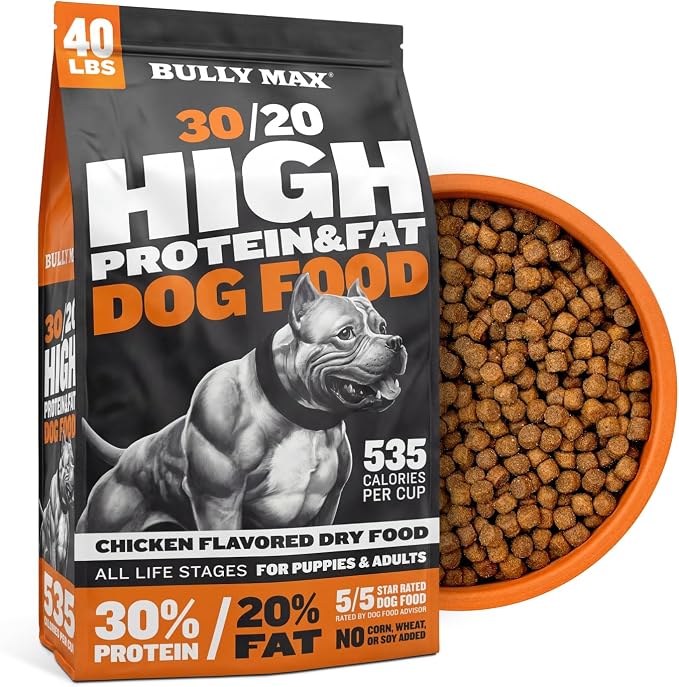
No — and this is the claim competitors almost never challenge. AAFCO has no breed-specific nutrient profile, so there is no official standard a food must meet to be “for Bullies.” What brands like Bully Max sell is a standard high-protein, high-calorie adult formula (their 30/20 is 30% protein, 20% fat, ~535 kcal/cup, per Bully Max’s own nutrition tables) dressed in bully branding. Judge every food on protein, fat, calorie density, and the AAFCO statement — the rest is marketing.
How much protein does a Bully need to hold muscle?
For most adult Bullies, 25–30% crude protein from animal sources is the practical target — enough amino acids for muscle repair without loading a couch companion with unneeded calories. Senior Bullies arguably need the upper end: aging dogs lose muscle more easily, so protein should stay high even as calories come down.
Where protein comes from matters more than the headline number: named meats and meat meals supply complete amino acid profiles, while plant-boosted proteins can inflate the crude protein figure.
Calories and weight: the half most owners get wrong
The breed’s biggest nutrition problem isn’t too little food — it’s too much. Bullies are easy keepers, and extra weight on a 70–100 lb frame stresses hips and elbows. You should feel the ribs under a light fat cover and see a waist from above and the side. Measure every meal with a real measuring cup and weigh the dog monthly. If weight creeps up on reduced portions, suspect too many treats, table scraps, or an underactive thyroid — talk to your vet; our guide on dog foods for hypothyroidism explains how thyroid-driven weight gain changes the feeding math. For always-“starving” dogs, see our high-fiber dog food guide.
How much to feed: a table by weight
This is the original math behind the “how many cups” question. Vets start from the resting energy requirement, RER = 70 × (body weight in kg)^0.75, then multiply by a life-stage factor. We used the factors from Dr. Jennifer Coates on PetMD: 1.6 for a typical neutered adult and 2 for a puppy over 4 months. Use your dog’s ideal weight, not the scale number if he is overweight.
| Ideal weight | RER (kcal) | Neutered adult (× 1.6) | Puppy 4 months+ (× 2) | Cups/day of a 415 kcal/cup food (adult) |
|---|---|---|---|---|
| 50 lb (22.7 kg) | 727 | ~1,160 kcal | ~1,455 kcal | ~2.8 |
| 60 lb (27.2 kg) | 834 | ~1,335 kcal | ~1,670 kcal | ~3.2 |
| 70 lb (31.8 kg) | 936 | ~1,500 kcal | ~1,870 kcal | ~3.6 |
| 80 lb (36.3 kg) | 1,035 | ~1,655 kcal | ~2,070 kcal | ~4.0 |
| 100 lb (45.4 kg) | 1,223 | ~1,960 kcal | ~2,445 kcal | ~4.7 |
Worked example: an 80 lb neutered Bully is 36.3 kg. 36.3^0.75 ≈ 14.8, so RER ≈ 70 × 14.8 ≈ 1,035 kcal; × 1.6 ≈ 1,655 kcal/day. Divided by 415 kcal/cup (Bully Max 25/11) is about 4 cups. On a 535 kcal/cup food the same dog needs only about 3.1 cups, which is why calorie density matters more than the brand. For puppies, the puppy column is the weight the dog is now, and it is a starting point only: a growing large-breed pup should be fed to stay lean (see below), so reduce if you cannot feel the ribs easily. Intact dogs, very active dogs, and dogs losing weight use different factors; our dog calorie calculator does the cups math for any bag. These are estimates, not a prescription — your vet can set a target for your dog.
Reading the label: a quick checklist for Bully owners
Apply this to any bag, bully-branded or not: named animal protein or meat meal first (beef, chicken, fish); crude protein 25–30% from animal sources; crude fat matched to activity (~12–15% for a calm house Bully, up to 20% for an active one); an AAFCO statement for adult maintenance or all life stages; calorie density in kcal/cup printed plainly — your portion-planning number; and, for heavy builds, added glucosamine/chondroitin and omega-3s as sensible supporting players. Skip vague terms like “meat and bone meal”.
Skin issues and allergies: what nutrition can and can’t do
Bullies are overrepresented in the itchy-dog crowd, and food gets blamed more often than it deserves. Most recurring skin trouble is environmental (pollen, dust mites) or secondary infection — not food. The only reliable way to find out is an elimination-challenge diet trial run with your vet: one novel or hydrolyzed protein, nothing else crossing the dog’s lips, for at least eight weeks, with skin signs often improving by week five, according to VCA Animal Hospitals. VCA also warns that blood, saliva, and hair “allergy tests” are unreliable.
Omega-3 fatty acids from fish oil are the best-supported nutritional lever for skin. But no kibble “cures” allergies — a chronically itchy Bully with paw-chewing or ear infections needs a vet, not a shopping trip. Our food allergy guide walks through how vets actually diagnose the problem.
Grain-free, legumes, and the heart-health question
Bullies don’t need grain-free food — no breed does — but the heart question deserves a straight answer. The FDA’s investigation into diet-associated dilated cardiomyopathy (DCM) began in 2018, and the picture has sharpened since. As Tufts University’s Petfoodology summarized in June 2026, the association tracks with diets high in pulses — peas, lentils, chickpeas, dry beans — grain-free or not, not with the mere absence of grains. Early-caught cases can slowly improve when the diet changes.
Practical takeaway: if you feed grain-free, check that the formula isn’t just grains swapped for a wall of peas and lentils, discuss any pulse-heavy diet with your vet, and report coughing, exercise intolerance, or fainting promptly.
Joint stress under a heavy frame
The single biggest nutritional lever for a heavy frame is weight: lean body condition does more for joints than any supplement. Glucosamine, chondroitin, and EPA/DHA are reasonable supporting ingredients but don’t reverse arthritis. A Bully who is stiff after rest or reluctant on stairs needs a vet visit.
Formulas compared on label and spec
Honest note: Hands-on feeding trials with real dogs are planned but haven’t happened yet. Everything below is label and specification analysis — guaranteed analysis, ingredients, calorie density — plus owner-review data, not test results from this site.
VICTOR Hi-Pro Plus (30/20). 30% protein / 20% fat from beef, chicken, pork, and fish meals at about 405 kcal per cup, gluten-free, made in VICTOR’s own Texas facility, AAFCO all-life-stages. Suits active Bullies; for a sedentary dog it’s easy to overshoot, so measure carefully.

Bully Max 30/20. 30% protein, 20% fat, ~535 kcal per cup, no corn, wheat, soy, or poultry by-product meals, all life stages. Note from Chewy’s product Q&A: it contains sorghum and brown rice — not grain-free, despite the performance branding. Genuinely too rich for a low-activity dog; a legitimate pick for hard keepers and very active Bullies.
Bully Max 25/11. The interesting one: 25% protein with only 11% fat and 415 kcal per cup, marketed for lean muscle and weight management. For the far more common case — a Bully that needs to lose weight — this lower-fat profile makes more sense than the 30/20 most lists push.

Taste of the Wild Wetlands. In Hepper’s 2026 hands-on roundup, their testers named this their best overall pick for the breed, citing 32% protein from duck and chicken meals, chelated minerals, and probiotics at a competitive price (their testing is theirs, not ours). Hepper’s testers also flagged Victor Select as best value.
Diamond Naturals. A budget-friendlier route to meat-first, high-protein feeding with probiotics included. Bullies eat a lot, and a lower price per pound is a real consideration — solid guaranteed-analysis numbers without the performance-brand markup.

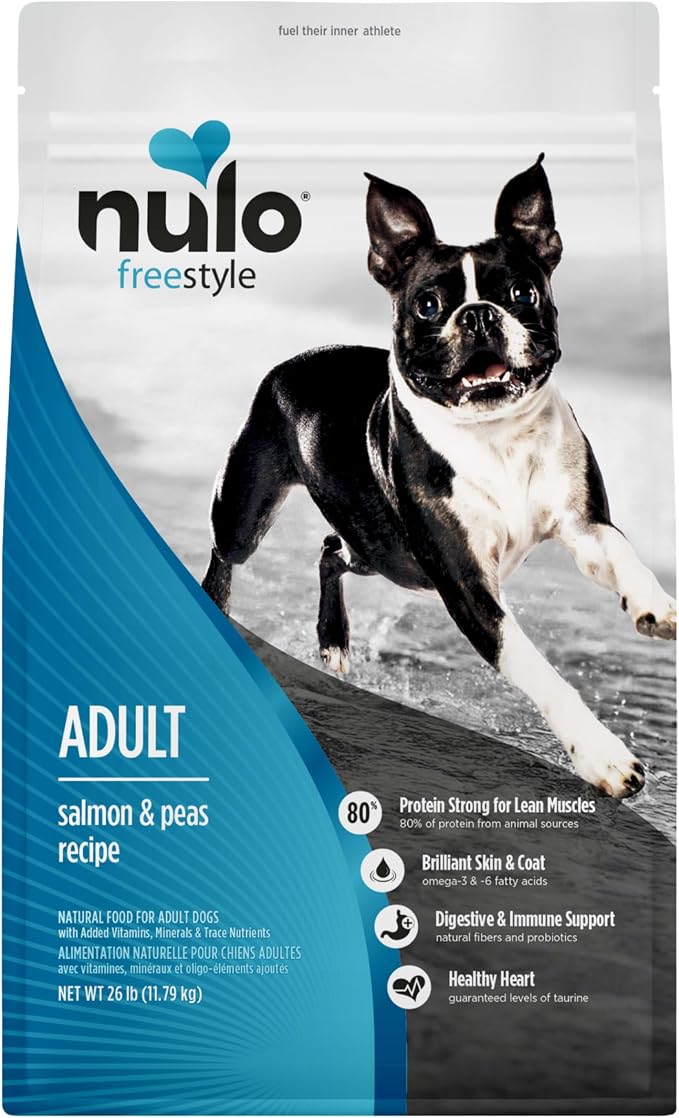
Nulo Freestyle. A high-meat, grain-free line (~30% protein, mostly from meat) with the BC30 probiotic for digestive support. A reasonable middle ground between budget and ultra-premium — though if you go grain-free, see the DCM section above and keep pulse content in check.
What owners actually report: review-mining
Owner reviews are self-selected, not controlled tests. Across Chewy’s review pools, observed September 2026: VICTOR Hi-Pro Plus holds about 4.3/5 from roughly 4,000 ratings (72% positive on digestibility, 77% on palatability); multiple reviewers stress transitioning slowly to avoid digestive upset. Bully Max 25/11 sits at 4.4/5 from 208 ratings (85% positive on digestibility and palatability); recurring themes include successful weight loss and diarrhea when owners switch too fast. Bully Max 30/20 shows 4.6/5 from 30 ratings, but palatability scores lower at 71% positive. Across all three: transition over 7–10 days.
Feeding a Bully puppy, adult, and senior
Puppy (up to roughly 12–18 months): see the next section — the rules are different from adult feeding.
Adult (roughly 2–7 years): 25–30% protein, fat matched to activity, portions anchored to ideal weight.
Senior (around 7–8+ for large, heavy breeds): metabolism slows while muscle loss accelerates, so the move is fewer calories, same or higher protein — not the old low-protein senior formulas. Keep protein up to defend muscle, and consider softer textures if teeth or appetite fade. Our best senior dog food guide details what changes at this stage, and the senior nutrition guide covers the full transition.
What to feed an American Bully puppy
Short answer: a puppy food that is labeled for growth of large-size dogs, fed in measured portions so the pup stays lean. Here is why, and what to look for.
- Look for the AAFCO large-size wording. AAFCO’s growth profile has a separate calcium limit for dogs expected to reach 70 lb or more as adults, and labels must say either “including growth of large-size dogs (70 lb or more as an adult)” or “except for growth of large-size dogs” (Merck Veterinary Manual, dog and cat foods). Many Standard and XL Bullies end up above 70 lb, so choose the “including” wording. Smaller Pocket and Classic types still do fine on it. The adult-only and “except for large-size” bags are the ones to avoid for a big pup.
- Why calcium matters. VCA explains that puppies cannot regulate calcium absorption the way adults do, so excess calcium can cause skeletal malformations, and excess calories can lead to obesity and orthopedic problems (VCA, large and giant breed puppies). That is also why VCA advises against adding calcium supplements. Adult formulas have a different calcium-to-phosphorus profile.
- Calories, not just protein. Calorie needs are highest in the first four months and then taper. Treats should stay under about 10% of daily calories (same VCA source). A high-fat performance formula is the wrong tool for most Bully pups.
- Meals. AKC suggests four meals a day at 6–12 weeks, three at 3–6 months, two from 6–12 months; large breeds typically switch to adult food around 12–14 months, and “better to be on puppy food a little too long than not long enough” (AKC, puppy feeding fundamentals). Weigh the pup weekly.
If you are choosing between brands, ask your vet or breeder which large-breed puppy formula fits your dog; this page’s adult list is not a puppy recommendation. Our Rottweiler feeding guide goes through large-breed puppy growth in more detail — the principles are the same for any heavy-framed breed.
How we picked these formulas
Three inputs, and you should know all three: (1) label and specification analysis — guaranteed analysis, ingredient order, calorie density, and AAFCO statements; (2) aggregated owner-review data from retailers like Chewy, framed as observed review sentiment, not our findings; (3) veterinary and academic sources for the nutritional claims (AAFCO profiles, Tufts on DCM, VCA on allergy trials). Hands-on feeding trials with real dogs are planned for a future update. No manufacturer paid for placement. Some product buttons are Amazon affiliate links, which earn this site a commission at no cost to you; they did not decide which foods are listed.
FAQ
Is high-protein food bad for an American Bully’s kidneys?
No — in healthy dogs, dietary protein doesn’t cause kidney disease; healthy kidneys metabolize and excrete excess protein without damage. If your dog has diagnosed kidney disease, that’s a vet-directed diet conversation, not a reason to avoid protein in a healthy Bully.
Is Bully Max just marketing, or is it actually good food?
It’s genuinely high-protein, calorie-dense kibble — the guaranteed analysis is real — but there’s nothing nutritionally “bully-specific” about it, since AAFCO has no breed-specific standard. Buy it for the specs (30/20 for hard keepers, 25/11 for weight management), not the branding.
How many cups should I feed my American Bully per day?
Use the table above: a neutered 80 lb Bully lands near 1,650 kcal/day, about 4 cups of a 415 kcal/cup food. Measure precisely and adjust monthly on body condition.
What is the best food for an American Bully puppy?
A puppy food labeled for growth of large-size dogs (70 lb or more as an adult), fed in measured meals so the pup stays lean. Avoid calcium supplements and rich performance formulas unless your vet says otherwise. See the puppy section above.
What dog food is best for bully breeds in general?
For American Bullies, American Staffordshire Terriers and similar bully types, the same rules apply: 25–30% protein from named animal sources, calories matched to activity, and portions based on ideal weight. Dogs of the smaller bully types need fewer cups; use the table above and adjust by body condition.
Do American Bullies need grain-free food?
No. No breed needs grain-free, and many Bullies thrive on wholesome grains like rice, barley, or oatmeal. If you do choose grain-free, watch the pulse content (peas, lentils, chickpeas) given the research into diet-associated DCM, and discuss the choice with your vet.
When should my Bully switch to senior food?
Large, heavy breeds are typically considered senior around 7–8 years, but the trigger is changing needs: portions that used to maintain weight now add pounds, or muscle tone softens. Our senior food guide explains what to change.
Should I add supplements to build my Bully’s muscle?
A complete, high-protein food already provides the building blocks; “muscle-building” supplements are largely unproven. Ask your vet about omega-3s and joint support instead.
The bottom line
Feed the Bully in front of you: 25–30% quality protein, measured portions, and joint-aware nutrition for the heavy frame. For the common case — a house Bully drifting toward chunky — a moderate-fat formula like Bully Max 25/11 or a measured portion of VICTOR Hi-Pro Plus beats any “maximum bully” calorie bomb. And as your Bully’s muzzle grays, revisit the whole equation: our senior dog nutrition guide walks through keeping protein high while calories come down, so the muscle that defines the breed lasts into the senior years.